For founders, owners, and product leaders who can change what they sell
How Steve Jobs Built Products,From the Macintosh to the First iPhone
Written down by Jay Elliot, the Senior Vice President who sat on his right in the product reviews… so you can run the same review on your own product this weekend.
When the product is right, it does more of the selling.
Physical + digital book · 5 companion tools · Instant digital access · 30-day keep-the-book guarantee
The Macintosh years. Jay Elliot (circled) with Steve Jobs and the Macintosh team.
Senior Vice President of Apple, reporting to Steve JobsApple's sales grew from $150 million to more than $3 billion during his tenure
The story
The man Steve Jobs trusted to tell him he was wrong wrote down how the products got made.
From: the desk of Keith Bresee, Coeur d'Alene, Idaho
Dear Founder,
In 1980, Jay Elliot was sitting in the lounge of a restaurant, waiting to meet a recruiter. He'd spent years at IBM, helped design one of its software labs, and left. He'd just finished a short, unhappy stint at Intel under Andy Grove.
He was 44, 6-foot-5, and still dressed like an IBM executive. A scruffy twenty-something in jeans sat down next to him and started talking. When he heard Jay had been at IBM, he said he was going to bury IBM.
Jay didn't argue. He asked, "How?"
The kid said the future wasn't corporate computing. It was personal computing. He wanted to put a computer in everybody's hand.
That was Steve Jobs, and that conversation was the interview. When Steve offered him the job, Jay said, "I don't think you can afford me." Apple went public later that year. They could afford him.
The finger, and the deodorant stick.
The first Saturday after Jay said yes, Steve picked him up in the silver Mercedes and drove him to Xerox PARC, barely saying why. They stood at a workstation and watched a clumsy 3-button pointing device move information around a screen without anyone typing a command.
On the way to the car, Steve held up his index finger and said, "This is going to change the world."
Not the mouse. The finger.
That afternoon, back in Cupertino, Steve sent an engineer to the pharmacy for a roll-on deodorant stick and a soap tray. That was the first prototype of the 1-button mouse. Not pretty. But an object on the table, where it could be argued with.
That's the part of the Steve Jobs story that never made the keynote. He didn't decide from documents. He put the thing on the table, and he kept people around him who'd argue with what they saw.
What you're buying is the product creation, review, and revision system Steve Jobs used from the Macintosh through the first iPhone…
Apple's general management team, 1984. Steve Jobs and Jay Elliot stand side by side at far right.
Every week, the people responsible for the Macintosh put the actual work on a table in a small room. A prototype, a screen, a component. About 20 people, maybe 30, out of almost 5,000 at Apple.
If someone said a feature would work, that wasn't enough. They wanted the thing in their hands so everyone could react to the same thing.
Jay sat on Steve's right. Steve was left-handed. Jay's job, in his own words, was to keep the disagreement useful: hear the expert, make sure Steve understood the constraint, and keep 2 angry sides from becoming the only result.
Here's what that looked like. The Mac's in-house drive project had grown to about 300 people, and the test results were horrible. Every team leader wanted it killed. Steve couldn't bring himself to do it. In front of the room he turned to Jay and said, "Jay, I wish you could hover above the meeting and tell me what to do."
They went for a walk. Jay told him to kill it, and committed to finding every one of those 300 people another job inside Apple. Steve walked back in, sat down, and said, "Okay, Jay has decided to kill the project."
Around the company, as Jay tells it in The Steve Jobs Way, Steve's line was: "Don't trust anyone over forty… except Jay."
That's the function.
Not the person who agrees with you. The person who puts the product in the room and says what they see.
Almost nobody builds that chair on purpose. Steve did.
The $100 bet.
In 1984 the Macintosh shipped, and months later it wasn't selling the way Apple's sales organization had projected. Steve flew to New York to find out why, and he did the thing almost nobody does. He went and stood where the buyer stood.
The original Macintosh, 1984.
He and Jay spent the day in computer stores. Steve hung back in the aisles and listened to clerks talk people who'd come in for a Mac into buying a PC instead. They found 1 clerk who didn't know how to operate one.
Then, over dinner, Jay said the thing Steve didn't want to hear: nobody knows what the Mac is.
Steve was sure that couldn't be true. The most talked-about computer in America, and nobody knew what it was? So Jay bet him $100 that not 1 person in that restaurant could say what a Macintosh was.
Steve took the bet. They went and asked. Not 1 person knew. A few guessed it was a variety of apple. Steve had to count those as wrong.
Jay won. Steve, who never carried money, never paid.
That's the whole book in 1 scene. The truth about your product is outside the room. It doesn't come to you. You have to build the way in, and you need someone at the table who'll tell you what they found.
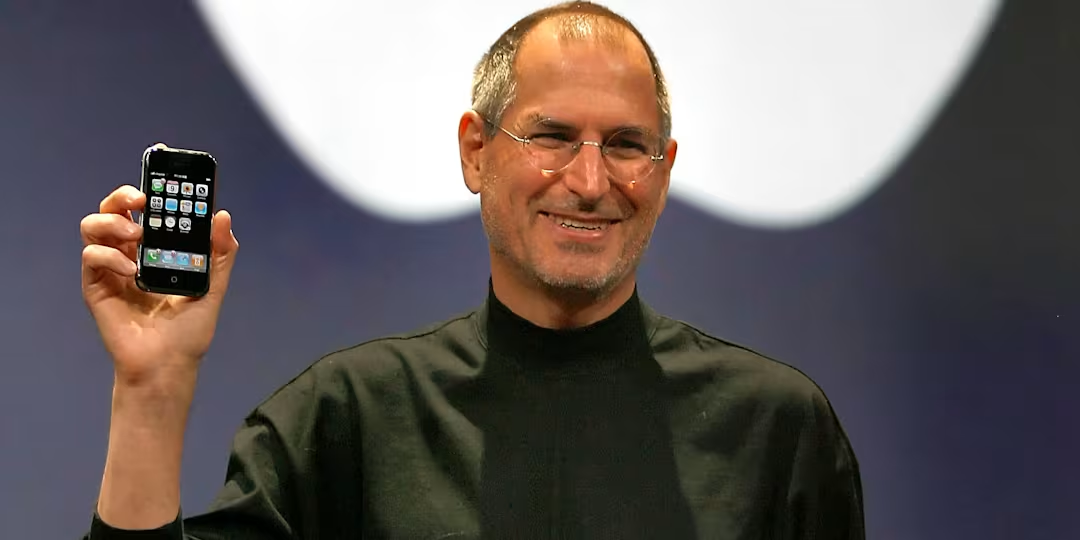
Decades later, the same man held the first iPhone.
Jay left Apple after Steve did. The title ended. The friendship didn't. Through NeXT, Pixar, the iMac and the iPod, Steve kept calling Jay whenever he wanted a direct reaction to something.
Steve Jobs with the iPhone.
One day the call was, "I want to show you something."
Jay drove to Cupertino. Steve took him into a conference room full of engineers who'd just brought him the first prototype of the iPhone.
Jay picked it up. It didn't feel right. Too thick. It bulged in his hand.
"Well, it's a great product, but I don't like the way it feels in my hand."
Steve said, "I think the same thing."
The engineer said, "Nope, that's the best we can do."
Steve gave them a deadline to make it thinner. They beat it.
The work was presented as done. The expert answer was on the table. And the final word went to the hand holding the product, because that was the standard Steve had run since the Macintosh, and he'd called back the man who helped build it.
The technology had changed completely. The standard hadn't.
Jay wasn't at Apple for the iPhone, and the book doesn't pretend he was. The standard took shape in the Macintosh reviews, between Steve and Jay. Steve kept it for the rest of his career. And that story isn't in either of Jay's earlier books.
The system Steve Jobs used from the Macintosh through the first iPhone, written down by the man he called back to hold the phone.
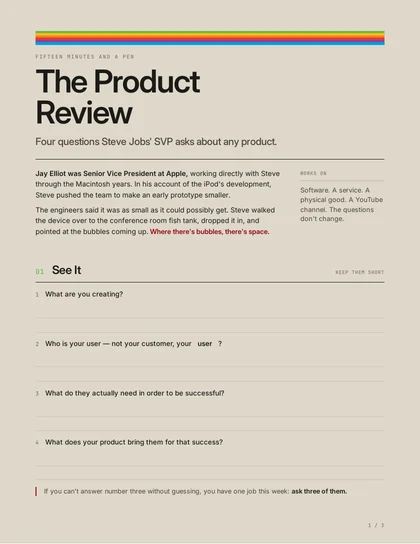
When I asked Jay what he'd put in 1 letter to a young founder starting a company today, the answer came out whole. It's about the product. And then 4 questions:
What are you creating?
Who is your user?
What do they really need in order to be successful?
What does your product bring them for that success?
Simple enough to fit on an index card. Hard enough to expose the assumptions a whole company has been protecting. In Jay's words: "I have seen a weak answer survive for years behind presentations, technical language, and activity."
I asked him to write it down. He gave me the raw material and the standard: his talks and interviews, his 2 published books, and the stories that never made it into either of them. Each chapter starts with something he watched happen from a few feet away and ends with the work. The worksheets are printed inside.
What it does for your product
Most products need the marketing to carry them. This builds one that carries the marketing.
Steve Jobs with the original Macintosh.
A stranger gets what you sell in 1 sentence. Customers come back on their own. Referrals show up without being manufactured. That's how the next customer gets cheaper instead of more expensive.
1984 → Today
Your competitors have the same ad platforms, the same AI, and the same templates.
The tools are getting easier to copy. The experience of using your product isn't.
The Macintosh story matters here because the standard wasn't the technology alone. It was what happened when someone put their hands on the product. That is still the test.
Everyone can get the tools.
The ad platforms.
The AI.
The templates.
You still have to build the experience.
A stranger understands what you sell.
The product does the job they came for.
They come back and bring someone with them.
A nod to 1984. The machine changes. The person using it still gets the final word.
Ads get someone to try you once. The product is what gets them to come back and bring someone with them.
How you run it
Put the actual product on the table.
Use it.
Ask the 4 questions.
Give the person holding it the final word over the expert explaining it.
Make 1 decision: fix, cut, reposition, test, create, or stop.
Revise.
Put it back on the table.
The first pass takes 1 weekend.
Friday night, the 10-minute Constraint Finder and the book, with your product beside you.
Saturday, the product on the table and the 15-minute Product Review.
Sunday, the customer conversations you can complete.
Monday morning, 1 page on the table: the decision, the assumptions under it, the evidence you have, the evidence you still need, and the date of the next review.
After that, it's weekly.
Picture that meeting. The ads person has a theory. You slide 1 page across the table with the evidence and the customer language you collected. Now the conversation is about what the user was trying to do, what the product promised, what actually happened, and which decision the evidence supports next.
Inside the book
"The hands, not the wallet." The definition of a user that keeps the product tied to the person who has to use it… and why BART was the customer and the rider was the user.
1,000 people against a nearly finished fare machine. "They destroyed it." The rule Jay took from it: when you use the machine, you know something the builders don't.
The paragraph test. Explain the product out loud. If it takes a paragraph, something's wrong. Jay tells you which to fix… the words or the product.
"Okay, I'm the product." Steve's exercise for narrating everything that happens to the customer, in order.
The watch people wouldn't buy. Jay's own product, loved by everyone he handed one to and bought by almost no one.
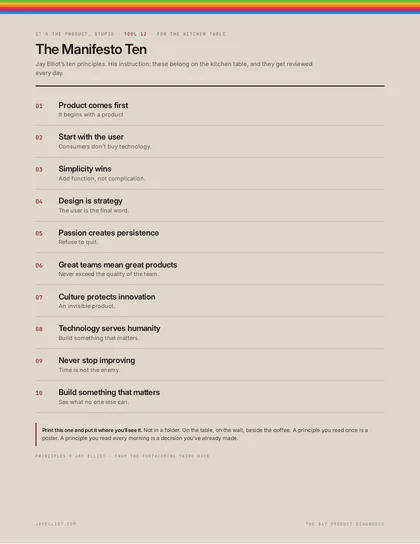
The 10 sentences for the kitchen table. The principles Jay wants kept close enough to irritate you into using them.
Who it's for
1 question decides it: can you change the product without asking permission?
Founders, owners, solo builders, creators with a flagship offer, product leaders with the authority to change what ships.
It applies to software, physical products, services, memberships and media; the book runs the 4 questions on a computer, a wetsuit, a fare machine, an animated movie and a hearing aid. You need a product that's shipped or seriously in build.
If you want ad scripts or funnel templates, or you plan to read without doing the work, this isn't your book.
Everything included
Here's everything you're getting today.
The digital book and 5 companion tools in your Bandley Way library. Instant access. One payment for the book. Nothing recurring unless you choose it.
(Bandley Way is named for Bandley Drive, the Cupertino street where the Macintosh team had a building of its own. That's in the book too.)
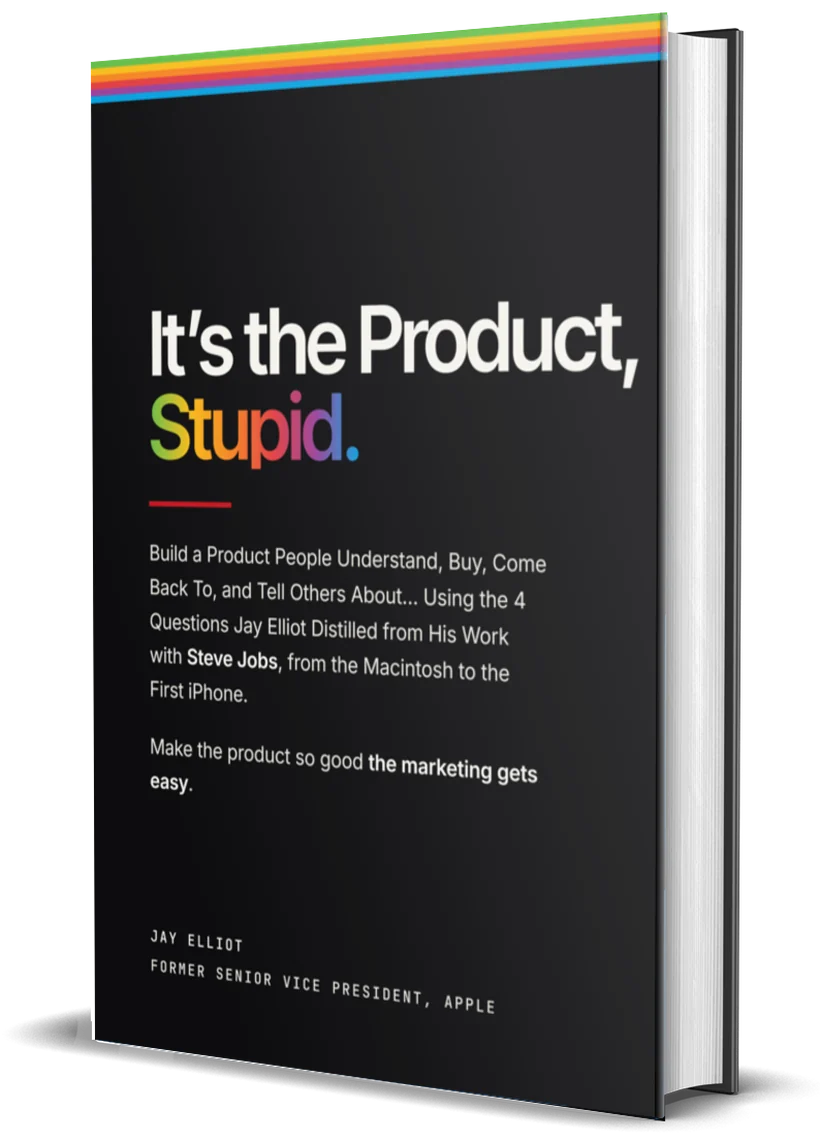
The book · It's the Product, Stupid
50 years of product judgment from inside Apple, IBM and Intel… written as a letter to one founder. Every chapter opens with something Jay watched happen from a few feet away, tells you plainly what it teaches, then gives you the work.
11 chapters, a start-here diagnosis, the worksheets printed inside, and 4 closing letters… including one to Steve.
"Don't trust anyone over forty… except Jay." — Steve Jobs, as Jay tells it in The Steve Jobs Way
$47
Companion tool 1 of 5 · Included
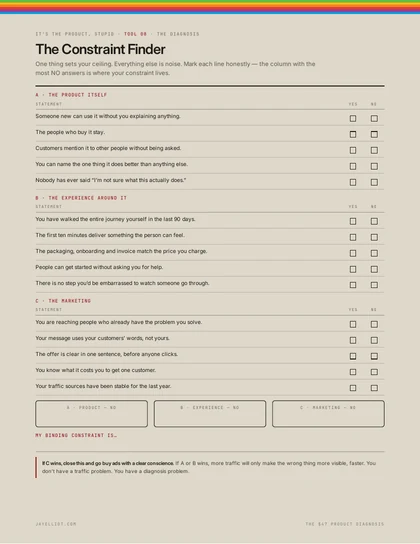
10-Minute Constraint Finder
15 statements across 3 columns: the product, the experience around it, the marketing. Answer from what you've observed and compare the result. It gives you a place to investigate first… and a way to stop treating every theory as equally likely.
Companion tool 2 of 5 · Included
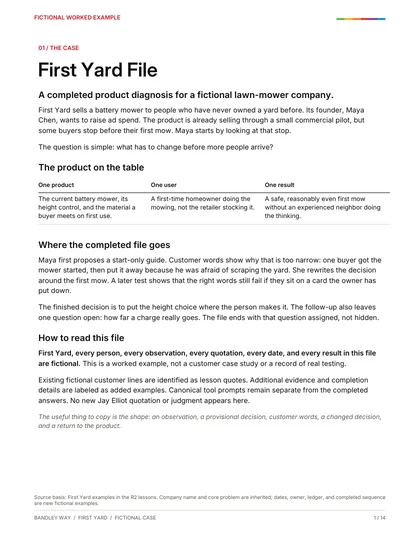
First Yard File
A completed fictional product diagnosis to follow. See a lawn-mower company move from an assumption to customer evidence, change its decision, and return to the product. The people and results are invented; the example shows you how to do the work.
Companion tool 3 of 5 · Included
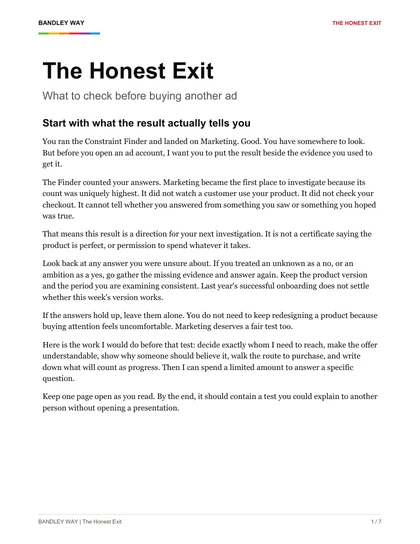
The Honest Exit
What to check when the evidence points to marketing. Define the person you need to reach, make the offer understandable, inspect the route to purchase, and set up a limited test before buying more attention.
Companion tool 4 of 5 · Included
The Manifesto Ten
Jay's 10 principles, formatted for the kitchen table. Put them where you'll see them. Read them until they annoy you.
Companion tool 5 of 5 · Included
The Product Review
The 15-minute worksheet. Answer the 4 questions, look at what your presentation communicates, decide what to cut, and put the product into 1 clear sentence. A place to start… and to return to after you make a change.
Why $47
Because this is a book meant to be used by a founder before the next quarter's budget goes out the door, and the goal is to put it in the hands of people who'll run it Monday morning. There's no subscription behind it.
There is a catch, and I'd rather tell you now.
After you buy, I'll tell you once about The Review Room, where founders put their actual product on the table every week with other people in the chair. It's separate, it costs more, and you don't need it to get everything out of the book.
Secure checkout · Instant digital access · Physical copy ships to you
30day guarantee
The 30-day keep-the-book guarantee
Read it. Use the tools on your product.
If you don't believe it was worth $47, email pirates@bandleyway.com within 30 days and we'll refund it. You keep the book and all 5 tools.
No form. No argument.
Before you decide
Is this just another collection of old Apple stories?
No. The stories show the system operating in real situations. The system is what you're buying. Jay organized the product discipline behind those stories so you can apply it to the product in front of you. Every major idea returns to work you can do and a decision you can make.
Is this really the same system Steve Jobs used?
Yes. Define the product and the user. Put the actual product in the room. Demonstrate it. Challenge the assumptions. Treat the user's experience as evidence. Cut or revise what weakens the central idea. Make a decision. Review the product again.
The book doesn't promise you Apple's resources, Steve's instincts, or Apple's results. It gives you the questions, principles, review discipline, and companion tools. What you build with them remains your responsibility.
Jay wasn't at Apple for the iPhone. How is this the same system?
Right, and the book says so. Jay was inside Apple for the Macintosh, sitting in the weekly reviews on Steve's right. He'd left by the time the iPhone was built. Steve called him back to hold the first prototype and say what he saw… the same standard, applied by the same person, 2 decades apart.
The headline is about the system Steve ran from the Macintosh to the first iPhone. Jay witnessed it at both ends.
Did Apple use these exact companion tools?
No, and Jay says so in the book: "We did not use a numbered workbook at Apple. We brought the real product into review, used it, argued about it, decided what had to change, and brought it back after the work was done." The underlying system is the system Jay documents Steve using. The 5 companion tools help you apply it through worksheets, a fictional worked example, a marketing guide, and printable principles. They're not presented as archival Apple documents.
What if the problem really is my marketing?
Then that's useful to learn. The system isn't designed to make the product guilty. It's designed to help you distinguish product, experience, and marketing before choosing the next investment. If the evidence points to distribution or communication, fund that work with a clearer reason. The Honest Exit is included for exactly that case.
Can I get my product reviewed by someone else?
Not as part of this purchase. The book is built for you to run yourself, and most founders should run it themselves first.
If you want a standing room where your product gets reviewed live, with other founders in the chair, that's The Review Room. It's separate, it's run by me, and you'll hear about it once after you buy.
How is everything delivered?
The digital edition of It's the Product, Stupid and 5 companion tools are available in your Bandley Way library after purchase. The physical edition is coming… and everyone who buys the digital edition before it ships gets the print version free.
The choice
The REAL choice is clear.
Most founders in this spot have already paid the price for a long time.
They've paid with ad spend asked to solve a problem nobody had located yet.
With agency retainers, each one finding a differently shaped problem and billing for the search.
With features built because somebody asked, maintained forever, for customers who never came.
With whole quarters, 90 days at a time, spent testing somebody else's theory while the real constraint sat there untouched.
And with the quiet one: watching a product they believe in grow slower than it should, and not being able to say why.
The question isn't whether you'll pay a price. The next quarter's budget gets spent either way… on a diagnosis or on a guess.
Jay already paid the true price. 50 years of building products… watching them succeed, watching them fail, disagreeing with Steve, learning from Jack O'Neill, making the mistakes in companies of his own. He wrote the lessons down so you don't have to pay for them twice.
You can spend the next 3 months rewriting ads, rebuilding pages, and hiring the next agency that finds the next differently shaped problem…
Or you can spend $47 today and one honest weekend with the thing you actually sell… and find out what's really been in the way.
The book costs $47. 3 more months of guessing will cost more.
$47 · Digital and physical book · 5 companion tools · One payment · 30-day keep-the-book guarantee
Secure checkout · Print edition free for digital buyers when it ships
Until then, to the thing you are building,
Keith Bresee
Producer, It's the Product, Stupid · Coeur d'Alene, Idaho
P.S. What you're buying is the product creation, review, and revision system Steve Jobs used from the Macintosh through the first iPhone… written down by the man he called back to hold the phone.
If the evidence points to marketing, that's not a failure of the book; your next marketing dollar finally has a reason behind it.
And if the product or experience is making marketing carry too much of the sale, you'll know where to begin before another quarter is spent compensating for it.